
Table of Contents
- Average Cost of Window Replacement 2026
- Signs You Need New Windows
- Window Materials and Energy Efficiency: What Actually Matters
- How to Choose a Window Contractor
- Tax Credits, Rebates, and Disposal: What Most Guides Miss
- DIY vs. Professional Installation: Risks and Trade-Offs
- Frequently Asked Questions
Last Updated: September 13, 2026
Average Cost of Window Replacement 2026
Window replacement pricing depends on window count, frame material, glass package, and installation complexity. At EFER Renovations Inc., we give no-obligation estimates because a real figure requires measuring your actual openings.
What Drives Your Total Project Cost
Four variables move your total most:
- Window count and size. Standard sizes cost less; custom dimensions add material and labor time.
- Frame material. Vinyl sits at the budget end, fiberglass and wood at the top.
- Glass package. Double-pane with Low-E and argon costs more than clear double-pane but pays back through thermal performance.
- Installation type. A full-frame replacement with new flashing and trim takes longer than a pocket insert.
Labor, permits, and structural repairs found once the old units come out round out the bill, which is why two houses on the same street can receive very different quotes.
The most common mistake homeowners make is comparing quotes by bottom-line price alone. A low bid that skips flashing, air-sealing, or permit pulls can leave you with leaks and failed building code inspections that cost more to fix than the difference you saved.
Signs You Need New Windows
Window failure starts in the sealed glass unit or the frame and sash. Diagnosing which one failed determines whether you need a glass-only swap or a full unit replacement.
Run This Five-Minute Self-Check First
Before you call anyone, walk the house and test each opening:
- The candle or incense test. On a windy day, hold a lit candle or smoking incense stick an inch from the frame perimeter. A flickering flame means air is moving through a gap, separating an air-leak problem (often fixable with weatherstripping or caulk) from a glass problem.
- The dollar-bill test. Close the window on a dollar bill at several points around the perimeter. If you can pull the bill out with no resistance, the weather seal has compressed and is no longer doing its job.
- The flashlight test at night. Have someone stand outside with a flashlight while you stand inside in a dark room. Light leaking around the sash tells you where the frame is failing.
- The press test on wood frames. Press a screwdriver handle into the sill and lower corners. If the wood gives or crumbles, you have rot, which almost always extends beyond the visible soft spot.
What Each Symptom Actually Tells You
- Fogged, cloudy, or hazy glass between the panes. The hermetic seal on the insulated glass unit (IGU) has failed: the argon or krypton fill escaped and moisture entered the cavity. This is a glass failure, not a frame failure, but on a unit older than about 15 to 20 years, a full replacement often makes more sense than a glass-only swap.
- Condensation on the interior face of the glass in cold weather. Usually a humidity and thermal-performance issue, not a seal failure. Older clear double-pane units without Low-E run colder and reach the dew point sooner; a Low-E coating raises that surface temperature and is the biggest reason a new unit stops sweating.
- Condensation between the panes. This is the definitive sign of a failed seal, and it cannot be cleaned or repaired, the IGU has to be replaced.
- Drafts you can feel along the frame. Confirm with the candle or dollar-bill test. A leak at the sash perimeter may be a gasket issue; a leak at the frame-to-wall junction means the flashing or air-sealing behind the trim has failed, a bigger, wetter problem.
- Difficulty opening, closing, or locking the sash. On vinyl and wood, this usually means the frame warped or swelled; on double-hung and casement units, the balance or hinge hardware may have failed. Hardware is replaceable; a warped frame is not.
- Visible rot, soft spots, or peeling paint at the sill and lower corners. Water pools at the sill, so that is where rot starts. If the sill is soft, assume the rough opening behind it has been getting wet.
- Rising energy bills with no change in habits. The weakest standalone signal, since rates and weather move too. Treat it as a prompt to run the tests above, not as proof.
- Street noise that has gotten louder indoors. A failed seal or single-pane unit transmits far more sound. If noise increased suddenly, suspect a seal failure rather than gradual wear.
One Failed Window Does Not Mean Replace Them All
Treating one fogged unit as a whole-house verdict is a common, expensive mistake. Windows fail on different schedules depending on orientation and exposure. A room-by-room assessment, noting the age stamp on each IGU, usually printed on the glass spacer, tells you which units are at end of life. Replacing in phases spreads the cost and prioritizes the worst-performing openings first.
The cost of delay is not just comfort. A failed seal or a leaking frame-to-wall junction lets water into the wall cavity, where it can rot sheathing and framing for years before it shows on the interior. By the time you see a stain on the drywall, the repair has moved from a window line item to a carpentry and drywall line item.
Window Materials and Energy Efficiency: What Actually Matters
Two decisions determine how a new window performs: the frame material and the glass package. Get both right and you gain draft reduction, UV protection, and lower heating and cooling loads. Get either wrong and you have paid for a window that underperforms its rating.
Frame Materials Compared: Vinyl, Wood, and Fiberglass
Each material trades cost against durability and thermal bridging: heat travels through solid material far faster than through trapped air, so any continuous conductive path from interior to exterior acts as a short circuit around your insulation.
| Material | Thermal Performance | Maintenance | Best For |
|---|---|---|---|
| Vinyl | Good, with multi-chambered vinyl extrusion | Low, wipe clean | Budget-conscious whole-home projects |
| Wood | Excellent when maintained | High, requires painting and sealing | Historic homes and custom interiors |
| Fiberglass | Excellent, minimal expansion and contraction | Low | Extreme temperatures and long-term durability |
Vinyl dominates the market because the extrusion process allows hollow chambers that trap air and improve insulation. Its weakness is heat: in extreme sun and temperature swings it expands and contracts more than fiberglass, which over decades can stress seals and bow the frame. It is also hard to repair cosmetically and cannot be painted reliably.
Wood has the best natural insulating value of the three, but it is only as good as its finish: every breach in the paint or sealant is a path for moisture, and moisture rots wood. It demands repainting and resealing on a schedule, short in humid or coastal climates. Its real advantage is aesthetic and structural: it can be milled to match historic profiles and accepts fasteners and hardware in ways vinyl cannot.
Fiberglass frames are glass fibers bonded in resin, giving them a very low rate of expansion and contraction, close to that of the glass itself. That matters because when frame and glass move at different rates, the seal between them is stressed. Fiberglass holds its shape across temperature swings better than vinyl or wood, making it the material of choice in climates with large temperature deltas. It costs more than vinyl and less than high-end wood, and it can be painted.
Glass Technology: Low-E, Argon Fill, and U-Factor Explained
Low-E glass is coated with a microscopic metallic layer that reflects heat back into the room in winter and blocks solar heat gain in summer. Argon gas fill is an inert gas sealed between panes that slows heat transfer better than air because it is denser. U-factor measures how quickly a window loses heat; lower is better. The three work together: Low-E handles radiant heat, the gas fill handles conductive and convective heat, and the spacer handles the edge.
The other ratings to check on the label:
- Solar heat gain coefficient (SHGC): how much solar heat passes through. Lower numbers mean less cooling load. In hot climates you want a low SHGC; in cold climates a moderate SHGC lets useful winter sun in.
- R-value: the insulation value of the assembly. Window R-values are far lower than wall R-values, a good window is around R-3 to R-5, while a wall may be R-13 or higher, which is why windows are always the weak point of the envelope (energy.gov).
- Condensation resistance: how well the unit resists interior moisture buildup.
- Visible transmittance (VT): how much daylight passes through. Higher VT means a brighter room but often a higher SHGC, so these two trade off.
- Energy Star certification: confirms the unit meets efficiency thresholds for your climate zone.
Spacer systems matter more than most buyers realize. The spacer is the bar holding the panes apart at the edge. Older aluminum spacers conduct heat and cold straight through, creating a cold band where condensation forms. A warm-edge spacer made of a low-conductivity material reduces that thermal bridging, which is why two windows with identical center-of-glass U-factors can perform very differently at the edges.
The Technology Most Guides Skip: Dynamic and Smart Glass
The fastest-moving change in residential glazing is glass that changes properties on demand. Two categories matter in 2026:
- Electrochromic glass tints electronically when a small current is applied, letting you darken a window to cut glare and solar heat gain without closing a blind. It is most useful on west- and south-facing windows that overheat in summer, and it can tie into a home automation system to tint on a schedule or in response to sunlight.
- Thermochromic and photochromic glass changes tint in response to heat or light without any wiring or power. It is simpler and cheaper than electrochromic but gives you less control.
Both remain a premium option versus a standard Low-E IGU, and both add electronics or specialty coatings that can affect warranty and repairability. If you are replacing windows on a sun-blasted elevation and already have a smart-home hub, dynamic glass is worth pricing. For the rest of the house, a well-specified Low-E argon unit with a warm-edge spacer delivers most of the benefit at a fraction of the cost.
Ask your contractor for the NFRC label on the specific unit being installed, not a brochure for the product line. The label lists the tested U-factor, SHGC, and visible transmittance for that exact configuration. A product line can carry several different ratings depending on the glass package and spacer chosen, so the label is the only way to know what you are actually buying.
The frame and the glass are a system, not two separate purchases. A premium Low-E IGU in a poorly insulated frame will underperform, and a top-tier fiberglass frame with clear double-pane glass will too. Specify both together, and match the SHGC to your climate rather than defaulting to the lowest number.
How to Choose a Window Contractor
Choose a window contractor by verifying licensing, insurance, manufacturer certifications, and warranty terms before you discuss price. A contractor who hesitates on any of those four is one to skip.
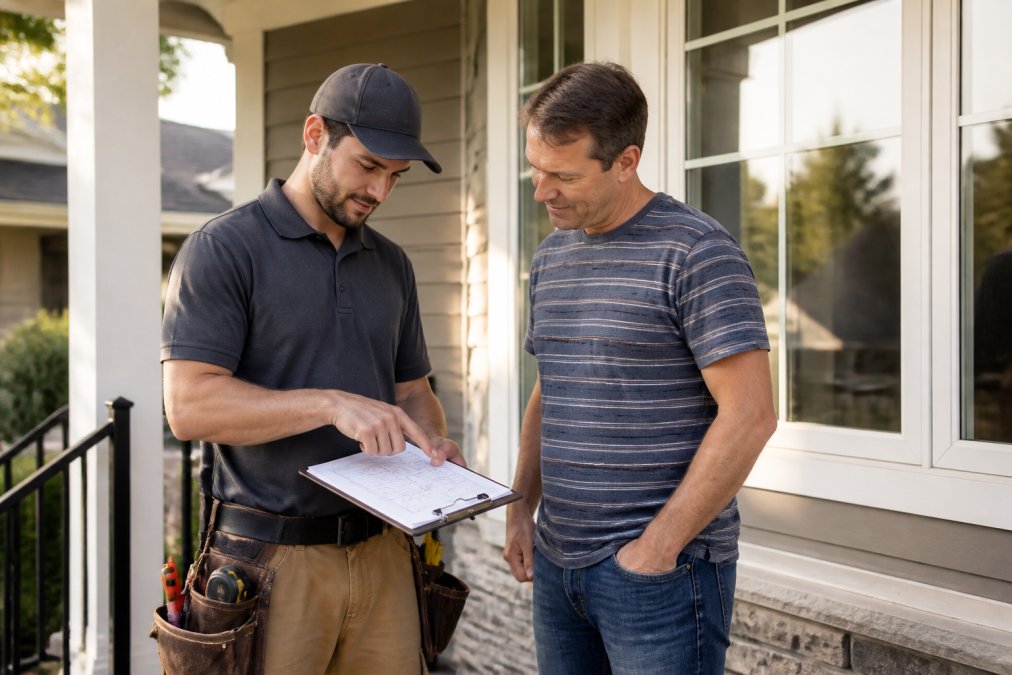
Run every candidate through this checklist:
- Ask for the license number and verify it with your state’s licensing board.
- Request a certificate of insurance for both general liability and workers’ compensation.
- Confirm manufacturer certifications, such as GAF, Owens Corning, or IKO credentials for exterior work.
- Get the workmanship warranty in writing, including its length and what it covers.
- Ask who pulls the permit and whether it is included in the quote.
- Request local references from projects completed at least a year ago.
A warranty is only as good as the company behind it. A ten-year workmanship warranty from a business with a long local track record means something; the same paper from a company that formed last spring means very little.
EFER Renovations Inc. has served homeowners across New Jersey and Eastern Pennsylvania for over 13 years, holds GAF, Owens Corning, and IKO certifications, and backs its work with a 10-year workmanship warranty. The company also handles insurance claims assistance and 24/7 emergency repairs, which matters when storm damage forces a fast decision.
Tax Credits, Rebates, and Disposal: What Most Guides Miss
Most window guides stop at cost and efficiency. The two items they skip are the money you can recover and the waste you create.
Tax credits and rebates. Federal and state programs for energy-efficient home improvements change from year to year, and eligibility depends on the specific U-factor and SHGC ratings of the units you install. Because the rules and dollar amounts shift, check the current requirements on the [Energy Star federal tax credits for home(/senior-discounts-for-home-exterior-renovations/) improvements | energystar.gov] and the Database of State Incentives for Renewables and Efficiency before you sign a contract. Your contractor should be able to confirm which units on their quote meet the current thresholds.
Disposal and environmental impact. Old windows do not belong in a landfill by default. Vinyl can often be recycled through dedicated programs, glass can be reprocessed, and wood frames can sometimes be salvaged. Ask your contractor where the old units go.
Budget for the rebate paperwork before installation, not after. Confirm which specific units qualify, keep the NFRC labels and your invoice, and file within the program’s deadline. Miss the window and the credit is gone.
DIY vs. Professional Installation: Risks and Trade-Offs
Professional installation is the right call for most homeowners, and the reason is not skill alone. It is the consequences of getting the details wrong.
Window replacement is a building envelope job. The window itself is only half the work; the flashing, air-sealing, insulation, and trim around it determine whether the unit performs. A poorly sealed opening lets water into the wall cavity, where it can rot framing and sheathing for years before you notice.
Where DIY makes sense:
- Replacing a single interior-trimmed unit in a low-risk location
- Working on a shed or outbuilding where code requirements are lighter
- Handling interior trim and painting after a professional install
Where it does not:
- Any second-story or above-grade opening
- Historic districts with strict exterior requirements
- Any job requiring a permit or an inspection
- Storm-damage replacements tied to an insurance claim
The insurance angle is the one people overlook. When a claim is involved, an unpermitted or improperly documented installation can complicate or void the payout. A licensed contractor who documents the work protects your claim as well as your wall.
EFER Renovations Inc. is best for homeowners and property managers who want the permit, the insurance paperwork, and the installation handled by one licensed team, including 10% discounts for seniors and veterans and 24/7 emergency response.
Frequently Asked Questions
How much does residential window replacement cost in 2026?
Pricing depends on window count, frame material, glass options, and installation complexity. Vinyl double-hung windows generally cost less than fiberglass or wood, and triple-pane Low-E glass adds to the total. Labor, permit requirements, and whether structural repairs are needed also affect the final figure. Request a written, itemized quote from a licensed contractor so you can compare line items, not just bottom-line totals.
What are the signs you need new windows?
Common signs include drafts near frames, condensation between panes, difficulty opening or closing, visible rot or warping, and rising energy bills. If your windows are single-pane or older than 20 years, thermal performance has likely dropped. Weatherstripping wear and air-sealing gaps are cheaper fixes, but cracked glass, failed spacer systems, or structural frame damage usually mean replacement is the better investment.
How do I choose a window contractor I can trust?
Check for state licensing, general liability insurance, and workers’ compensation coverage. Ask for manufacturer certifications such as GAF, Owens Corning, or IKO, and confirm the workmanship warranty length in writing. Request local references and read recent reviews. A contractor who provides a detailed scope, timeline, and written estimate before asking for a deposit is a stronger sign than one who pressures you to sign on the spot.
Are there tax credits or rebates for window replacement in 2026?
Federal and state incentive programs change annually, and eligibility depends on Energy Star certification and specific U-factor and Solar Heat Gain Coefficient ratings. Check the Energy Star website and your state energy office for current programs before you buy. Your contractor should provide the manufacturer’s certification statement and NFRC ratings so you can submit accurate paperwork. Keep all receipts and spec sheets for your records.
What is the best time of year to replace windows?
Spring and fall offer moderate temperatures that make installation faster and more comfortable, and contractors often have more availability. Summer and winter projects are possible but may take longer if weather delays sealing or curing. Scheduling in the off-season can also mean shorter wait times. Ask your contractor about lead times for your chosen window style, since custom orders can add weeks regardless of season.
Can I install replacement windows myself to save money?
DIY installation is possible for experienced homeowners, but mistakes in flashing, air-sealing, and shimming can cause water intrusion, drafts, and voided warranties. Improper installation also risks failing a building code inspection. Professional installation protects the manufacturer’s warranty and ensures the U-factor and thermal performance ratings hold up in practice. For upper floors or complex openings, hiring a licensed contractor is the safer choice.