
Table of Contents
- Why a Professional Roof Inspection Matters More Than You Think
- The Top 7 Benefits of Professional Roof Inspection
- Signs of Roof Damage After a Storm: When to Call a Pro
- How Long Does a Roof Inspection Take? What to Expect
- How Inspections Support Your Insurance Claim and Warranty Compliance
- The 2026 Roof Cost Reality: How Inspections Factor Into the Average Cost of Roof Replacement 2026
- DIY vs. Professional Inspection: What’s the Real Difference?
- Conclusion: Schedule Your Professional Roof Inspection Today
- Frequently Asked Questions
Last Updated: September 5, 2026
Your roof is the first line of defense against the elements, yet it’s often the most neglected part of a home. A professional roof inspection is a comprehensive evaluation of your roofing system’s condition, identifying existing damage and potential weak points before they escalate. At EFER Renovations Inc., we’ve spent over 13 years inspecting roofs across New Jersey and Eastern Pennsylvania, and we see the same costly pattern repeat: homeowners skip routine checks and pay for it later.
Why a Professional Roof Inspection Matters More Than You Think
Most homeowners only think about their roof when something goes wrong, like a stain spreading across the ceiling or a shingle landing in the yard. By that point, minor damage has often already compromised the structural integrity of the roofing system. A professional inspection shifts the focus to preventive maintenance that catches small problems while they are still inexpensive to fix.
Water damage from an undetected leak can lead to mold growth, dry rot in the framing, and damaged insulation, threatening your family’s health and your property’s value.
The Top 7 Benefits of Professional Roof Inspection
Here are the specific ways a professional inspection pays for itself:
- Extends roof lifespan: Routine maintenance can add years of service life to your current roofing materials.
- Prevents costly emergency repairs: Catching a loose flashing or a small leak early avoids a full-blown crisis later.
- Maintains warranty compliance: Many manufacturers require documented inspections to keep your warranty valid.
- Simplifies insurance claims: Professional documentation provides clear evidence for claim approval.
- Improves energy efficiency: Identifying ventilation or insulation issues helps lower heating and cooling costs.
- Protects structural integrity: Early detection of moisture intrusion prevents damage to the decking and framing.
- Preserves curb appeal and property value: A well-maintained roof signals a cared-for home to potential buyers.
Extending Your Roof’s Lifespan
A professional roof inspection is an effective way to maximize the lifespan of your roofing system. Most roofing materials are designed to last decades, but only if properly maintained. Shingle degradation, granule loss, and lifted edges are issues a pro can spot and remedy before they necessitate a premature replacement.
Without this oversight, small problems compound. A single damaged shingle can expose the underlayment to UV rays and rain, accelerating wear across the entire roof surface.
Catching Small Issues Before They Become Costly Repairs
The financial difference between a minor repair and a major replacement is staggering. A professional will identify issues like cracked seals around vents, rusted flashing, or clogged gutters. Addressing these immediately is a fraction of the cost of replacing roof decking or repairing interior ceilings.
A tiny, pinhole leak can saturate insulation, rot wooden rafters, and create the perfect environment for mold in just a few months. A professional assessment catches these hidden leaks while they are still a simple fix.
Signs of Roof Damage After a Storm: When to Call a Pro
A storm can damage your roofing system, but the damage isn’t always obvious from the curb. Waiting for a storm to act is a reactive strategy. The most effective homeowners use a seasonal inspection rhythm to catch problems before they become emergencies, and to have a clear record of their roof’s condition when a storm does hit.
Spring Inspection Checklist: Recovering from Winter
Winter is brutal on roofing materials. The freeze-thaw cycle, ice dams, and heavy snow loads all take their toll. In early spring, once the snow has melted and the ground is dry, schedule a professional inspection to check for:
- Ice Dam Aftermath: Look for water stains on interior ceilings or walls, especially in the attic. These are signs that ice dams on the eaves may have forced water back under the shingles.
- Shingle Granule Loss: Check your downspouts and gutters for an accumulation of sand-like granules. This indicates accelerated shingle wear, often caused by ice or hail.
- Flashing Integrity: Examine the seals around chimneys, skylylights, and roof valleys. Winter’s expansion and contraction can crack these seals, creating a path for water.
- Gutter and Downspout Blockage: Clear out any debris that accumulated over winter. Clogged gutters force water to pool on the roof deck, leading to rot and leaks.
Autumn Inspection Checklist: Preparing for Winter
Before the first hard freeze, a second professional inspection is your best defense against winter damage. The goal is to ensure your roof is watertight and ready to shed snow and ice. Key focus areas include:
- Ventilation and Attic Airflow: Inadequate attic ventilation is a leading cause of ice dams. A professional will check that your ridge vents and soffit vents are clear and balanced to keep the roof deck cold and dry.
- Loose or Lifted Shingles: High winds from late-summer storms can loosen shingles without tearing them off. A pro will re-seal or replace these to prevent wind-driven rain from getting underneath.
- Tree Limb Clearance: Trim any branches that overhang your roof. In winter, the weight of ice and snow can cause limbs to snap and puncture your roofing system.
- Sealant and Caulking Check: The sealant around pipe boots, vents, and other roof penetrations degrades over time. Re-caulking these areas in the fall prevents leaks during the wettest months.
The Storm-Specific Trigger: When to Skip the Calendar
Certain storm events demand an immediate professional call, regardless of the date. Schedule an inspection within 48 hours of a storm if you observe any of the following:
- Hail Larger Than a Quarter: Hail impacts can bruise asphalt shingles, compromising their integrity without any visible cracking. This damage is often invisible from the ground and requires a hands-on inspection to detect.
- Wind Speeds Exceeding 60 mph: Sustained winds at this level can lift and loosen shingles even if they remain in place.
- Visible Debris Impact: A fallen tree limb or flying debris that strikes the roof surface can create hidden punctures.
A professional contractor trained in storm damage assessment will check for subtle signs of impact, granule loss, bruising, and sealant failure, that insurance adjusters are trained to find. Pairing a seasonal maintenance schedule with a rapid response after severe weather builds a documented history that strengthens any future insurance claim.
A seasonal inspection is not just about repairs; it is about documentation. A dated, professional report from a spring or autumn inspection provides a baseline of your roof’s condition. If a storm hits a month later, this baseline report is powerful evidence for your insurance claim, proving the storm, not prior neglect, caused the damage.
How Long Does a Roof Inspection Take? What to Expect
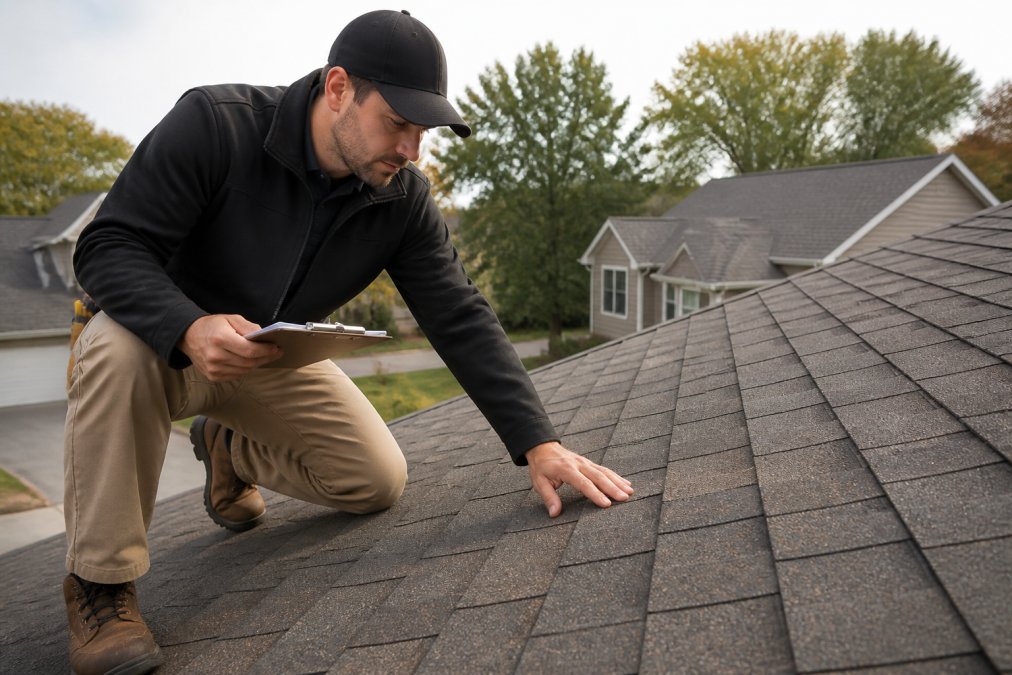
A standard professional roof inspection typically takes between 45 minutes and two hours, depending on the size and complexity of your roof (nahb.org). It covers a thorough examination of the roofing materials, flashing, underlayment, ventilation systems, and gutters.
Here is what you can expect during the process:
- Exterior Review: The contractor will examine the entire roof surface for shingle degradation, lifting, and missing pieces.
- Interior Check: They will inspect your attic for signs of moisture intrusion, inadequate ventilation, or light penetration.
- System Evaluation: This includes checking flashing around chimneys and skylights, as well as the condition of the gutter system.
- Documentation: You should receive a detailed report of findings, often including photos of any problem areas.
How Inspections Support Your Insurance Claim and Warranty Compliance
When a storm hits, the quality of your documentation often determines the outcome of your insurance claim. A professional inspection report provides the specific evidence adjusters need, proving the damage was caused by the weather event, not neglect.
Maintaining your roof warranty is usually contingent on regular upkeep. If a manufacturer sends an inspector to assess a failure and you have no record of professional maintenance, your warranty claim can be denied. Regular inspections provide the paper trail required for warranty validation.
The 2026 Roof Cost Reality: How Inspections Factor Into the Average Cost of Roof Replacement 2026
The average cost of roof replacement 2026 reflects significant increases in material prices and labor. While the exact figure varies based on square footage, roofing materials, and pitch, a full replacement is a major capital expense. Extending the life of your existing roof through regular inspections is one of the most financially prudent decisions you can make.
Think of an inspection as an insurance policy against the high cost of replacement. For a relatively small fee, you gain a professional assessment that can identify issues keeping your current roof functional for another five to ten years. Preventive maintenance is always cheaper than a premature full replacement.
DIY vs. Professional Inspection: What’s the Real Difference?
The table below outlines the core differences between a DIY visual check and a professional inspection. But the real difference, and the one most guides ignore, is not just about skill or equipment. It is about incentive. Understanding who is performing the inspection and why is just as critical as what they are looking for.
| Aspect | DIY Visual Check | Professional Inspection |
|---|---|---|
| Surface Review | Looks for missing or visibly damaged shingles | Identifies shingle degradation, granule loss, and “bruising” |
| Leak Detection | Checks for active ceiling stains | Uses thermal imaging to find hidden moisture and poor insulation |
| Safety | Risk of falls and roofing hazards | Trained in safety protocols with proper equipment |
| Documentation | Personal notes and photos | Detailed, inspection-ready reports for insurers and warranty validation |
| Expertise | General homeowner knowledge | Knowledge of flashing, ventilation, and manufacturer requirements |
Professionals also understand the nuances of different roofing systems. They know that a metal roofing installation has different failure points than an asphalt shingle roof. They can spot inadequate attic ventilation that causes ice dams in winter or premature aging in summer.
The ‘Paid vs. Free’ Inspection Dilemma: A Critical Distinction
Here is a nuance that most articles miss: not all professional inspections are created equal. The critical question is not just whether to hire a professional, but which kind of professional to hire. The distinction comes down to the business model behind the inspection.
The ‘Free’ Inspection: A Sales Lead in Disguise
Many roofing companies offer “free” inspections. These inspections are often loss leaders, marketing tools designed to generate sales leads for roof replacements or major repairs. The contractor’s primary goal is to find enough damage to justify an insurance claim or a replacement project.
This is not to say every free inspection is dishonest. Many reputable contractors offer them as a genuine service. However, the inherent conflict of interest is real: a contractor whose revenue depends on installing new roofs has a financial incentive to find problems that warrant a replacement.
The ‘Paid’ Inspection: An Independent Assessment
A paid inspection, typically costing between $150 and $400, is a different animal (angi.com). When you pay for an inspection, you are hiring an independent assessor whose primary service is the evaluation itself, not the repair work. This model aligns the inspector’s interest with yours: their job is to give you an accurate, unbiased picture of your roof’s condition.
This is the type of inspection you want when you need:
- An objective opinion on whether to repair or replace. If you are unsure whether a contractor’s recommendation for a full replacement is justified, a paid, independent inspection provides a second opinion free from sales pressure.
- Documentation for an insurance claim. A paid inspection report is often more detailed and defensible because the inspector is not a party to the repair contract.
- A pre-purchase or pre-sale assessment. When buying or selling a home, you need an unbiased evaluation to negotiate fairly.
How to Vet Any Inspector, Paid or Free
Whether you choose a paid or free inspection, you should always vet the inspector. Ask these questions before they set foot on your roof:
- Are you licensed and insured? This is non-negotiable for any contractor working on your property.
- What are your credentials? Look for certifications from manufacturers like GAF, Owens Corning, or IKO, which require ongoing training.
- Will you provide a written report with photos? A verbal summary is not enough. You need a documented record for your files, your warranty, and potential insurance claims.
- Do you have a conflict of interest? If the inspector also performs repairs, ask how they handle situations where a repair is more appropriate than a replacement. A transparent contractor will be happy to explain their process.
Be wary of any contractor who performs a “free” inspection and gives you a same-day estimate for a full roof replacement without showing you clear, photographic evidence of the damage. A legitimate professional will walk you through their findings and explain the difference between a repair and a replacement, even if it means a smaller job for them.
Conclusion: Schedule Your Professional Roof Inspection Today
The roof over your head works hard every day, and it deserves more attention than a passing glance. Ignoring the signs of wear and tear is a gamble where the house usually loses. A professional inspection is the smartest, most cost-effective way to protect your property, simplify insurance claims, and ensure your warranty remains intact.
At EFER Renovations Inc., our certified contractors provide comprehensive inspections that give you a clear picture of your roof’s health. With our 10-year workmanship warranty, senior and veteran discounts, and commitment to quality, we make it easy to protect your home. Contact Us Today to schedule your professional roof inspection and take the first step toward a safer, more durable home.
Frequently Asked Questions
Is a professional roof inspection necessary?
Yes. A professional roof inspection is necessary to identify hidden damage that isn’t visible from the ground. Trained inspectors can spot issues like shingle degradation, flashing problems, and underlayment failures that can lead to water damage, mold growth, and dry rot. Regular inspections also help maintain your roof’s structural integrity and are often required to keep your warranty valid, potentially saving you thousands in emergency repairs and extending your roof lifespan.
What will fail a roof inspection?
Common issues that fail a roof inspection include significant shingle degradation, such as curling, cracking, or missing granules, which indicates the end of the roof lifespan. Inspectors also flag damaged flashing around chimneys and vents, inadequate roof ventilation, signs of moisture intrusion like mold or dry rot in the underlayment, and compromised gutter systems. These problems compromise structural integrity and can lead to leaks and water damage, making a professional assessment crucial.
How much does a roof inspection cost, and is it worth it?
The cost of a roof inspection varies based on your location and the size of your home. While some companies offer free inspections, especially if you suspect storm damage, a paid inspection from a certified professional is a worthwhile investment. It provides a detailed, unbiased report on your roofing system’s condition, which is invaluable for planning maintenance, negotiating with insurance adjusters after storm damage, and avoiding surprise costs during the average cost of roof replacement 2026.
How often should you schedule a professional roof inspection?
You should schedule a professional roof inspection at least once a year, ideally during the spring or fall. Additionally, you need an inspection after any major storm to assess storm damage. Regular annual inspections help catch minor issues early, preventing costly emergency repairs and extending your roof’s lifespan. This proactive preventive maintenance is a key part of roof maintenance schedule and protects your property’s structural integrity.
This article was written using GrandRanker