
Last Updated: November 2, 2026
Quick Summary
Signs of moisture infiltration in commercial roofing include ceiling stains, dripping water, puddles near walls, musty odors, and soft or sagging ceiling tiles. Exterior signs include membrane blisters, cracks, damaged flashing, ponding water, and separated seams. Check interior areas first, then inspect the roof safely.
- Ceiling stains are often a lagging indicator, so the leak has usually been active for some time.
- Ponding water that sits more than 48 hours after rain signals poor drainage and membrane risk.
- Inspect interior ceilings within 24 to 48 hours of rain, when active leaks are most visible.
- Walk the roof only with fall protection and a spotter, and avoid surfaces you cannot identify.
- Infrared thermography reads surface temperature, so flagged areas should be confirmed with core sampling.
Table of Contents
- Why Moisture Infiltration Is Hard to Spot on a Commercial Roof
- Visible Interior Warning Signs: Stains, Drips, and Musty Odors
- Exterior Signs to Look for on the Roof Surface
- A Step-by-Step Safe Inspection Protocol
- Roof Leak or Plumbing, HVAC, or Condensation? How to Tell the Difference
- Commercial Roof Moisture Survey: Detection Methods and Their Limits
- Building a Commercial Roof Maintenance Checklist and Deciding Repair or Replacement
- Is Commercial Roof Repair Tax Deductible and What to Do Next
- Frequently Asked Questions
Moisture infiltration in commercial roofing is one of the most expensive problems a property manager can miss, because it rarely announces itself at the start. By the time a stain shows on a ceiling tile, water has often been moving through the roof assembly, insulation, and deck for weeks or months. The same early warning signs come up again and again across commercial roofs. Knowing what to look for, and in what order, lets you act before a manageable repair becomes a full replacement.
Why Moisture Infiltration Is Hard to Spot on a Commercial Roof
Commercial roofs are large, flat, and built in layers, which makes water easy to trap and hard to trace. Water can enter at a seam, travel along the roof deck, and surface several feet away from the actual breach. That gap between where water gets in and where it shows up is the core reason moisture problems go unnoticed.
Most commercial roof systems use a membrane over insulation over a structural deck. Once water reaches the insulation, it can stay saturated for a long time without any visible sign inside the building. Wet insulation loses its effectiveness and adds weight, which is why a problem that began as a small membrane defect can grow quietly.
Visible Interior Warning Signs: Stains, Drips, and Musty Odors
The clearest signs of moisture infiltration appear inside the building. Check these areas regularly:
- Ceiling stains: Brown or yellow rings on ceiling tiles often mark where water has soaked through and dried.
- Dripping water or droplets: Active leaks may show up only during or after rain.
- Puddles on floors: Standing water near walls or under light fixtures can point to a leak above.
- Musty odors: A damp, mildew-like smell often means water is trapped in insulation or the deck, even when no stain is visible.
- Damp or soft areas: Sagging ceiling tiles or spongy-feeling drywall indicate prolonged saturation.
Stains are often a lagging indicator. If you see one, the leak has usually been active for some time. Document any stain with dated photos so you can track whether it grows after each storm.
Exterior Signs to Look for on the Roof Surface
A roof walk, done safely, reveals problems that interior checks miss. Look for:
- Blisters and bubbles: Trapped moisture under the membrane can raise the surface into bubbles.
- Cracks and splits: Membrane cracks, especially along seams and at the edges, let water in directly.
- Damaged flashing: Check the metal and membrane where the roof meets walls, curbs, drains, and penetrations. Flashing failures are a frequent entry point.
- Ponding water: Water that sits for more than 48 hours after rain indicates poor drainage, and standing water accelerates membrane deterioration (Still Water Runs Deep – Proper roof slope and drainage are important to prevent excessive…).
- Deteriorated seams: Lifting or separated seams let water track underneath the roofing materials.
Walk the roof only if it is safe to do so. Use proper fall protection, and do not step on areas you cannot identify as structurally sound. Many roof surfaces look intact from the ground but are not safe to walk on.
A Step-by-Step Safe Inspection Protocol
Most commercial roof guides tell you what a leak looks like. Fewer tell you how to inspect in an order that protects both your people and the evidence.
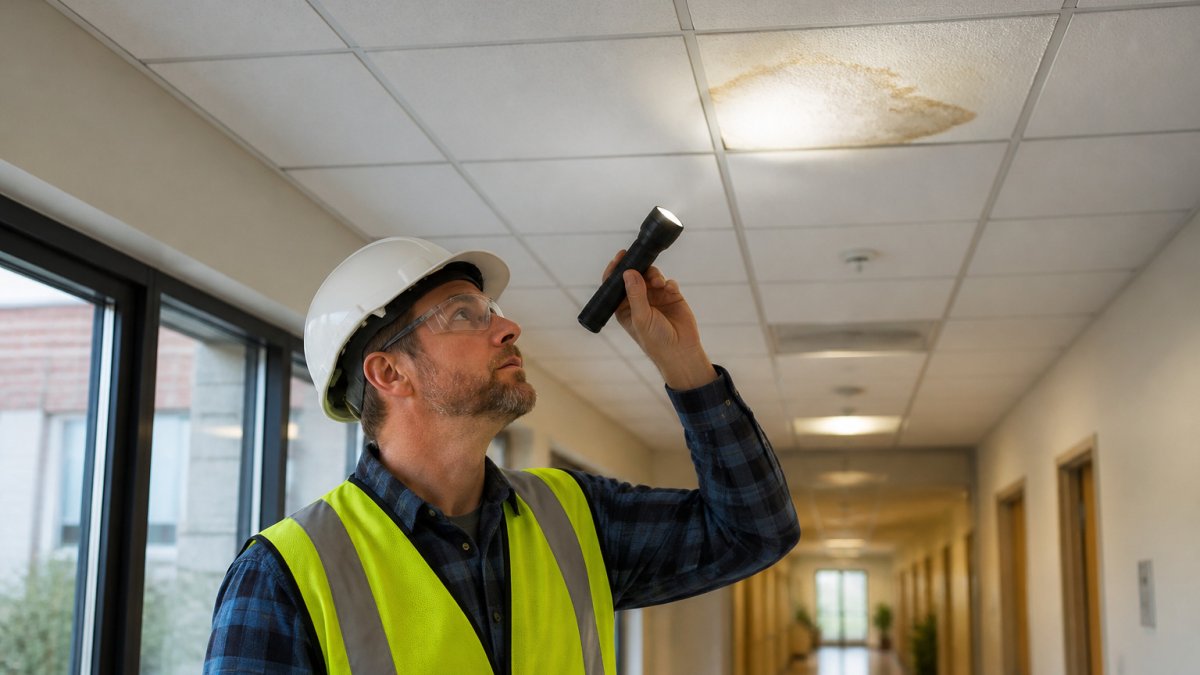
Step 1: Establish a baseline before the next storm. Walk every floor and note existing stains, discoloration, and soft ceiling tiles on a floor plan. Date and photograph each one.
Step 2: Inspect within 24 to 48 hours of rain. Active leaks are most visible while the assembly is still wet. Check ceilings, wall-to-ceiling joints, the tops of exterior doors, and the perimeter of light fixtures and HVAC registers.
Step 3: Map interior findings to roof zones. Cluster your findings on the floor plan.
Step 4: Inspect from the roof access point first. Before walking the field, look at what is visible from the hatch or ladder: roof edges, drain rings, scuppers, curb flashings, and penetration seals. Many failures are visible from a safe standing position and do not require a full roof walk.
Step 6: Walk the roof only with fall protection and a spotter. Stay on structurally supported paths, avoid ponded water and blistered membrane, and never step on a surface you cannot identify. Photograph defects in place with a reference object for scale.
Step 7: Document in a format a contractor can use. A useful record includes the date and time, weather conditions in the prior 48 hours, the location of each finding on the floor plan, dated photos, and a short note on whether the finding is new or pre-existing.
Step 8: Escalate based on what you found. Isolated interior stains with no visible roof defect call for a professional moisture survey. Visible membrane or flashing defects with active interior leaks call for a contractor visit before the next storm.
Roof Leak or Plumbing, HVAC, or Condensation? How to Tell the Difference
Not every stain comes from the roof. Plumbing leaks, HVAC condensation, and high indoor humidity can produce similar marks. Check these clues:
- Timing: A roof leak usually appears during or after rain. Plumbing leaks tend to be constant. Condensation tends to follow temperature and humidity cycles.
- Location relative to pipes and ducts: Stains directly under plumbing lines or HVAC ducts point away from the roof.
- Pattern: Roof leaks often produce stains that radiate from a single point or follow a line of structure. Condensation usually appears on cold surfaces such as uninsulated ducts or pipes.
- Water test: A controlled water test on the roof, run by a professional, can confirm whether the roof is the source.
When the cause is unclear, a contractor can isolate the source before any repair is made.
Commercial Roof Moisture Survey: Detection Methods and Their Limits
A visual inspection confirms what is visible. A moisture survey is how professionals find what is hidden under a membrane that still looks intact. The methods below are not interchangeable, each answers a different question, and each has failure modes that can produce a false negative or a false positive if used alone.
Infrared thermography. Wet insulation retains and releases heat differently than dry insulation, which shows up as a temperature contrast in a thermal image. Surveys are typically run at dusk or after a period of sun exposure, when the contrast between wet and dry areas is greatest.
Capacitance and nuclear moisture meters. These handheld tools measure moisture content in the roof assembly and are used to grid-scan the roof and map wet zones. They are faster than core sampling and non-destructive, but readings can be affected by membrane type, surface moisture, and the presence of metal or ballast.
Core sampling. A small cut through the membrane and into the insulation gives direct physical evidence: you can see and feel whether the insulation is saturated and how far the moisture extends.
How the methods are sequenced.
Why the survey matters for the repair-or-replace decision. The moisture map is what turns a symptom into a scope. Localized wet areas with sound membrane and dry surrounding insulation support a targeted repair. Wet areas that span multiple bays, saturated insulation across the field, or deck deterioration change the decision toward replacement.
When to question a survey result. If a thermal image flags an area but cores come back dry, the likely explanation is surface moisture, ballast, or a reflective coating rather than wet insulation.
Watch out: a survey report that lists wet areas without a roof plan, core locations, or a stated method is difficult to verify and easy to over-scope, ask for the mapping and the confirmation points before accepting a replacement recommendation.
Each moisture survey method answers a different question and has its own limits, as summarised below.
| Method | What it detects | Key limitation |
|---|---|---|
| Infrared thermography | Temperature contrast from wet insulation | Reads surface temperature, not moisture |
| Capacitance and nuclear meters | Moisture content in the roof assembly | Affected by membrane type, surface moisture, metal or ballast |
| Core sampling | Direct evidence of saturated insulation at specific points | Cannot map full extent between cuts |
Building a Commercial Roof Maintenance Checklist and Deciding Repair or Replacement
A regular maintenance checklist catches moisture problems early. Include a quarterly interior walk, a post-storm inspection, a semi-annual roof walk, and a review of drains and gutters. Keep a log of every finding and repair.
Once you find moisture, the decision is whether to repair or replace. Repair is usually appropriate when wet areas are localized, the membrane is otherwise sound, and the insulation is not widely saturated. Replacement becomes more likely when moisture covers large areas, the insulation is wet throughout, or the roof has reached the end of its service life. A moisture survey can help establish the extent of damage needed to make that call.
Is Commercial Roof Repair Tax Deductible and What to Do Next
Many property managers ask whether commercial roof repairs are tax deductible. Repairs that keep the roof in working condition are generally treated differently from improvements that extend its life or replace it entirely. Because the treatment depends on the specifics of the work and your business situation, confirm the details with a qualified tax professional before filing.
Right now, the most useful next step is to document what you have found and get it inspected. Start with the interior checks described above, photograph everything, and schedule a professional assessment before the next heavy rain. Early action keeps a moisture problem from turning into a larger repair. For a commercial roof assessment or an estimate, contact EFER Renovations Inc. today.
Frequently Asked Questions
What are the early warning signs of moisture infiltration in commercial roofing?
Early signs usually appear inside the building before anything is visible on the roof. Look for faint brown or yellow ceiling stains, peeling paint, bubbling drywall, and a musty smell in upper floors or near roof penetrations. Small drips after rain, or damp insulation found during a maintenance walk, are also strong indicators. Catching these early limits damage to the roof deck and insulation. If you see any of these, document them with dated photos and schedule a professional inspection before the next storm.
How can property managers distinguish between roof leaks and condensation?
Roof leaks tend to follow rain events and show up as stains that grow with each storm, often near flashing, drains, or seams. Condensation usually appears on cold surfaces during humid weather, often on the underside of the roof deck or near HVAC ducts, and it may dry out during the day. Checking whether the moisture appears only after rain, comparing it with HVAC run times, and looking for ponding water on the roof surface can help narrow the cause. When the source is still unclear, a qualified roofer’s inspection can help confirm it.
How often should commercial roofs be inspected for moisture?
Most commercial roofs benefit from a professional inspection at least twice a year, typically in spring and fall, plus a visual check after major storms. Property managers should also walk the roof and inspect interior ceilings monthly if the building has a history of leaks. Keeping a commercial roof maintenance checklist that records dates, findings, and photos makes trends easier to spot. Older roofs or roofs with heavy foot traffic may need more frequent checks.
Does commercial roof repair qualify as a tax-deductible expense?
Repairs and replacements are generally treated differently for tax purposes. Whether a specific job qualifies depends on its scope and your tax situation, so confirm the treatment with a CPA or tax advisor before filing. Keep detailed invoices that describe the work performed, since those records support any deduction you claim. For current pricing or a written scope of work, contact EFER Renovations Inc. directly.
