
Table of Contents
- Why Entry Doors Fail During Forced Entry
- Reinforcing the Door Frame and Jamb
- Installing Reinforced Strike Plates and Upgrading Deadbolts
- Replacing Hinges with Long Screws for Door Security
- Adding a Security Door Bar or Barricade
- How to Reinforce Entry Doors: Step-by-Step Installation
- Reinforcing Secondary Doors, Sliding Doors, and Patio Entries
- Fire Safety and Emergency Egress Considerations
- Frequently Asked Questions
Last Updated: October 19, 2026
Why Entry Doors Fail During Forced Entry
Entry doors fail because the frame and jamb are weaker than the door itself. Most doors are solid or reinforced, but the frame is just thin wood. When someone kicks hard, the jamb splinters and the door swings open.
The lock is only as strong as what holds it. A deadbolt anchored to thin wood won’t stop a determined intruder. The screws holding the strike plate are often short, they bite into the frame but don’t reach the wall studs behind it. This is the real vulnerability.
Here’s what happens during a forced entry attempt:
- The intruder targets the lock area, not the door itself
- Pressure on the handle or kick pushes the lock away from the frame
- If screws are short, the strike plate pulls free from the jamb
- The door opens even if the lock is engaged
- The entire security system fails because the weakest link broke first
Reinforcing the Door Frame and Jamb
The door frame and jamb need to be anchored directly to the wall studs. This is non-negotiable for real security. Most entry door frames are attached with nails or short screws that grip only the frame material itself, not the structural studs behind it.
Start by locating the wall studs. Use a stud finder or knock along the wall until you hear a solid sound. Studs are usually 16 inches apart. Mark them clearly.
The jamb, the vertical piece that holds the lock and strike plate, must connect to at least two studs. If your door is centered between studs, you’ll need to reinforce both sides.
How to reinforce the frame:
- Remove the trim or molding around the door if it’s in the way
- Drill pilot holes through the jamb into the studs behind it
- Use 3-inch screws or longer to anchor the jamb to the studs
- Install screws at the top, middle, and bottom of the jamb on both sides
- Check that the door still operates smoothly after tightening
This single step stops most casual forced-entry attempts. The door won’t budge because you’ve anchored it to the house structure, not just the frame.
Installing Reinforced Strike Plates and Upgrading Deadbolts
A reinforced strike plate is thicker than standard hardware and uses longer screws. The strike plate is the metal piece that catches the bolt when you lock the door.
Replace your strike plate with a heavy-duty version. These are inexpensive, usually under $20. Look for strike plates made from steel that are at least 1/8 inch thick. Cheap strike plates bend or break under pressure.
The deadbolt itself matters too. A Grade 1 deadbolt (the strongest rating) has a bolt that extends at least 1 inch into the strike plate. The bolt should be solid brass or steel, not plastic.
What to look for in a deadbolt:
- Grade 1 or Grade 2 rating (ANSI standard)
- 1-inch or longer bolt throw
- Solid metal construction
- Reinforced latch guard to prevent shimming
- Smooth, responsive mechanism
Install the new strike plate with 3 1/2-inch screws that reach the studs. Don’t use the screws that came with the plate, they’re usually too short.
Replacing Hinges with Long Screws for Door Security
Hinges are often overlooked in door security. Most doors have three hinges, and each one is a potential failure point. The hinge screws are typically short, they hold the hinge to the frame but don’t anchor deep into the studs.
Replace the hinge screws with 3-inch screws on at least the top and bottom hinges. These longer screws reach through the frame and into the studs, making it much harder to kick the door off its hinges.
You don’t need to replace the hinges themselves unless they’re damaged. Just swap out the screws. This is one of the fastest, cheapest upgrades you can make.
Hinge screw replacement steps:
- Open the door fully
- Remove one screw at a time from each hinge
- Replace with a 3-inch wood screw of the same diameter
- Tighten firmly but don’t over-tighten (you can strip the hole)
- Check that the door still closes smoothly
If your door has only two hinges, add a third one. Two hinges aren’t enough to support a door under stress. A third hinge distributes the load and prevents sagging.
Adding a Security Door Bar or Barricade
A security door bar is a metal rod that braces the door from the inside. It’s installed horizontally across the door at about waist height.
Door bars are effective because they work independently of the lock mechanism. Even if someone bypasses your deadbolt, the bar holds. They’re simple to install and inexpensive.
Types of security bars:
- Fixed bars that bolt to the frame on both sides
- Sliding bars that drop into brackets
- Portable bars that wedge against the floor and door
- Hinged bars that fold up when not in use
For maximum security, use a fixed bar that bolts directly to the frame studs. Portable bars are easier to install but less secure because they rely on friction and weight rather than mechanical anchoring.
Install the bar so it contacts the door at a solid point, not at the lock or handle. The brackets should be mounted to the studs using 3-inch screws. This prevents the bar from pulling free under pressure.
How to Reinforce Entry Doors: Step-by-Step Installation
This section walks you through a complete reinforcement project. Most homeowners can finish this in 4-6 hours using basic tools. The total cost depends on which upgrades you choose, but frame reinforcement and strike plate replacement are the highest priorities.
What You’ll Need Before Starting
Gather these tools and materials before you begin:
- Stud finder
- Drill with bits
- Screwdriver set
- Tape measure
- Level
- 3-inch wood screws
- 3 1/2-inch wood screws
- Reinforced strike plate
- Grade 1 deadbolt (if replacing)
- Security door bar or brace (optional)
- Shims (plastic or wood)
- Pencil
Phase 1: Assess Your Current Door Setup
Start by examining your existing door. Open it fully and look at the frame. Is the frame tight against the wall, or is there a gap? Gaps indicate the frame isn’t properly seated.
Check the hinges. Count them and look at the screw size. If you see short screws (under 1 inch), they’re a vulnerability. Mark the hinge positions so you remember where to upgrade the screws.
Test your deadbolt. Lock it and try to rattle the door. Does it move? If the frame shifts when you push, the frame isn’t anchored to the studs.
Locate the wall studs using a stud finder. Mark them lightly with pencil so you know where to drive long screws.
Phase 2: Strengthen the Frame and Jamb
This is the most important step. Remove any trim or molding that blocks access to the jamb screws.
Drill pilot holes through the jamb into the studs. Use a drill bit slightly smaller than your screw diameter. Pilot holes prevent the wood from splitting and make screws easier to drive.
Install 3-inch screws at three points on each side of the jamb: top, middle, and bottom. Start with the pilot holes you just drilled.
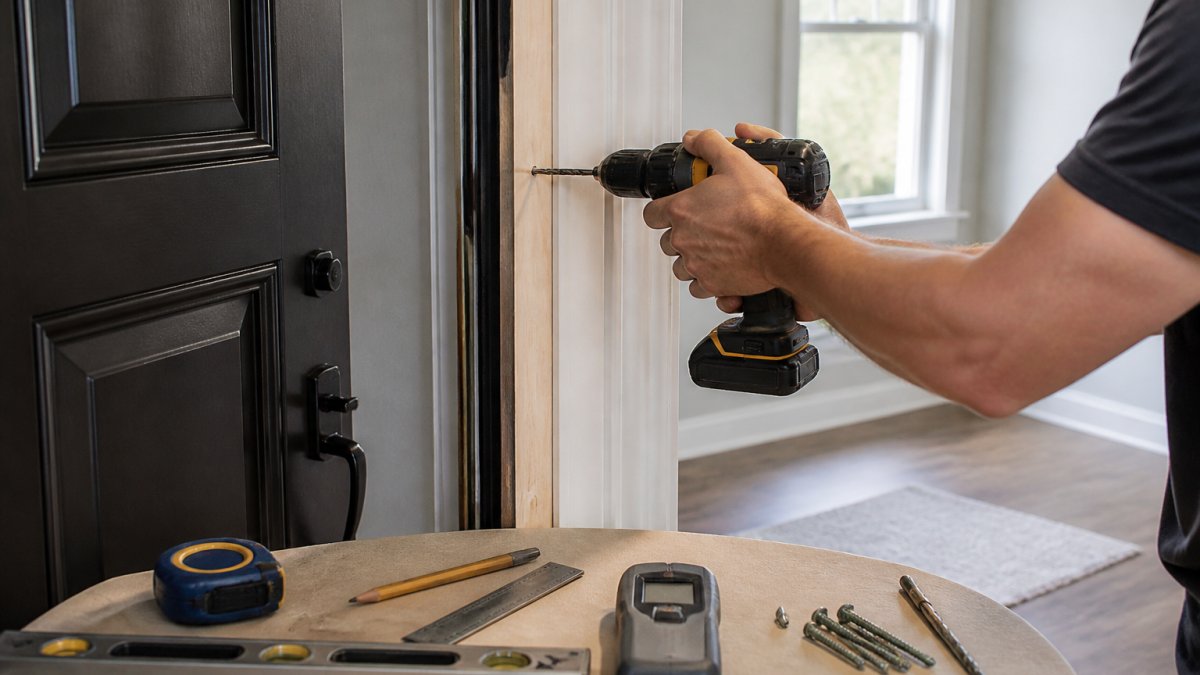
Check that the door still closes smoothly. If it binds or sticks, the frame may have shifted. Loosen the screws slightly and adjust, then retighten.
Phase 3: Upgrade Hardware and Add Reinforcement
Remove the old strike plate by unbolting it from the frame. Install the new reinforced strike plate in the same location. Use 3 1/2-inch screws in all holes.
If you’re replacing the deadbolt, remove the old one by unbolting it from inside the door. Install the new Grade 1 deadbolt following the manufacturer’s instructions. Make sure the bolt aligns with the strike plate opening.
Replace the hinge screws on the top and bottom hinges with 3-inch screws. Open the door fully so the hinges are accessible. Remove one screw at a time and replace it.
Install a security door bar if you’re adding one. Position the brackets on both sides of the door frame at waist height. Drill pilot holes and bolt the brackets to the frame studs using 3-inch screws.
Common Mistakes to Avoid
Don’t use short screws and expect them to hold. Short screws grip only the frame material, not the studs. They’ll pull free under pressure.
Don’t install hardware without anchoring to studs. A reinforced strike plate with short screws is almost as weak as the original setup.
Don’t forget the hinges. Many people reinforce the lock area but leave the hinges weak. A determined intruder can kick the door off its hinges if they’re not properly anchored.
Don’t over-tighten screws. This can strip the hole or warp the frame. Tight is good, stripped is not.
Don’t install a security bar without bolting it to the frame studs. A bar that’s only friction-fit or bolted to the frame (not studs) can be pried loose.
| Upgrade | Priority | Cost Range | Difficulty |
|---|---|---|---|
| Frame reinforcement with long screws | Highest | $50-100 | Moderate |
| Reinforced strike plate | High | $15-40 | Easy |
| Grade 1 deadbolt replacement | High | $40-100 | Moderate |
| Hinge screw replacement | Medium | $20-40 | Easy |
| Security door bar | Medium | $60-150 | Moderate |
Reinforcing Secondary Doors, Sliding Doors, and Patio Entries
Secondary entry doors need the same reinforcement as front doors. Back doors, side doors, and garage entry doors are common targets because they’re often less visible from the street.
Apply the same principles: anchor the frame to studs, upgrade the strike plate and deadbolt, and reinforce the hinges. The process is identical.
Sliding glass doors are more complex. They don’t have traditional locks or frames that can be reinforced the same way. For sliding doors, add a security bar that prevents the door from sliding open.
For patio doors, use a combination approach. Upgrade the lock if possible, but rely more on a security bar or brace.
Consider adding door and window sensors that trigger an alarm if the door is forced. These are inexpensive and work well for secondary entries.
Fire Safety and Emergency Egress Considerations
Reinforcing your entry doors improves security, but don’t compromise emergency egress. You must be able to exit quickly in a fire or emergency.
All deadbolts should be keyed on the outside but operate with a thumb turn on the inside.
Security bars should be removable from the inside without tools.
Check local building codes before installing reinforcements. Some jurisdictions have specific requirements for entry door security that you must follow.
If you have questions about code compliance, contact your local building department or fire marshal. They can review your reinforcement plan and confirm it meets safety standards.
For professional installation and code compliance verification, EFER Renovations Inc. offers door installation services.
Reinforcing your entry doors doesn’t have to be complicated or expensive.
Frequently Asked Questions
How do you secure a door from being kicked in?
Reinforce entry doors by upgrading to a heavy-duty deadbolt, installing a reinforced strike plate anchored deep into wall studs, and replacing short hinge screws with 3.5-inch screws. Add a security door bar or brace for extra protection. The jamb and frame are where most kick-in failures occur, so strengthen those first. A combination of these upgrades makes forced entry significantly harder.
Do longer screws make a door more secure?
Yes. Replacing standard 0.75-inch screws with 3.5-inch screws for hinges and strike plates anchors hardware into wall studs instead of just the jamb. This prevents the frame from splitting under impact. Longer screws distribute force across the structural frame, not just the thin jamb wood, which is the primary reason many entry doors fail during forced entry attempts.
What is the best lock for preventing forced entry?
A Grade 1 deadbolt with a reinforced strike plate is the strongest option. Look for deadbolts with at least a 1-inch throw bolt and a reinforced escutcheon plate. Pair it with a heavy-duty strike plate secured with 3.5-inch screws into studs. Smart locks add convenience but don’t replace mechanical security; use both for layered protection. Ensure the deadbolt and strike plate are compatible with your door material and thickness.
Can I reinforce an entry door myself, or do I need a professional?
Most reinforcement upgrades are DIY-friendly if you have basic tools: a drill, screwdriver, and saw. Replacing screws, installing a new deadbolt, and adding a strike plate take a few hours. However, if your door frame is cracked, the jamb is damaged, or you’re unsure about wall stud locations, professional installation ensures proper anchoring and compliance with local building codes. EFER Renovations Inc. offers expert door installation for those who prefer professional work.