
Table of Contents
- When Does Insurance Cover Roof Leaks?
- Roof Maintenance vs Storm Damage: What Insurance Covers
- How to File a Roof Insurance Claim
- Roof Leak Repair Cost: What to Expect
- Claim vs. Repair: The Cost-Benefit Analysis
- Roof Age and Coverage Limitations
- Navigating Claim Denials
- Conclusion
- Frequently Asked Questions
Last Updated: September 10, 2026
When Does Insurance Cover Roof Leaks?
Most homeowners assume their policy covers any roof leak. The reality is narrower: when asking does insurance cover roof leaks, a standard policy covers leaks caused by a sudden, accidental event listed as a covered peril, windstorm, hail, or a fallen tree, not age, neglect, or gradual deterioration.
That distinction decides almost every claim. This guide from EFER Renovations Inc. covers the coverage rules, the claim process, and the repair-versus-claim math.
Covered Perils vs. Policy Exclusions
A covered peril is a specific event your policy names as eligible for a payout. For roof leaks, the common ones are windstorm, hail damage, and a fallen tree or other impact. When one of these opens your roof to water, the resulting interior damage is usually covered too.
Policy exclusions remove coverage entirely. The standard exclusions that kill roof leak claims are:
- Wear and tear from normal aging
- Lack of maintenance, including clogged gutters and failed flashing
- Gradual seepage that built up over months
- Faulty workmanship from an earlier installation
The Insurance Information Institute’s guide to homeowners insurance explains that policies are written to cover sudden events, not the slow decline of a roof. That is the line every adjuster is drawing.
Sudden and Accidental Damage vs. Wear and Tear
Sudden and accidental damage happens in a single identifiable event, with no warning and no prior deterioration. A hailstorm that fractures shingles qualifies. A leak after fifteen years of sun exposure does not.
This is where most denials originate. Insurers look for evidence the roof was already compromised before the storm. Curling shingles, granule loss, and rusted fasteners all read as pre-existing wear, giving an adjuster grounds to reduce or deny the claim.
The burden of proof runs both ways. Dated photos taken right after the storm can establish that damage was new; photos taken three weeks later, after the leak has stained a ceiling, prove much less.
Never repair or replace a damaged roof before an adjuster inspects it. Once the evidence is gone, the insurer has no way to separate storm damage from wear and tear, and the claim is far more likely to be denied or reduced.
Roof Maintenance vs Storm Damage: What Insurance Covers
Storm damage is covered. Maintenance is not. That rule explains why so many claims fail.
If a windstorm lifts shingles and water enters, you have a claim. If the same leak appears because gutters were never cleared and water backed up under the roof edge, you have a maintenance problem and the policy will not respond. The result looks identical; the cause is what gets paid.
This is why roof maintenance matters beyond the obvious. A documented maintenance history is one of the strongest pieces of evidence you can bring to a claim, because it shows the roof was sound before the event. Without it, an adjuster has to guess, and guesses favor the insurer.
Here is how the two categories tend to break down:
| Cause of Leak | Typically Covered? | Why |
|---|---|---|
| Windstorm tears off shingles | Yes | Named covered peril |
| Hail fractures shingle surface | Yes | Named covered peril |
| Fallen tree opens the roof | Yes | Sudden impact |
| Clogged gutters back up water | No | Maintenance |
| Worn flashing around a chimney | No | Wear and tear |
| Leak after 20 years of sun exposure | No | Gradual deterioration |
How to File a Roof Insurance Claim
Filing a roof insurance claim follows a fixed sequence, and the order matters. Skip a step and you can lose the claim on procedure alone.
- Stop the water. Tarp the roof or move belongings out of the way. This is mitigation, and most policies require it.
- Document everything. Photograph the roof damage, the leaking ceiling, and any damaged personal property before you clean up.
- Call your insurer. Report the claim and get a claim number. Ask what your policy’s time limit is for reporting.
- Meet the adjuster. Be present for the inspection if you can. Point out specific damage rather than letting the adjuster work alone.
- Get a written scope. Ask for the adjuster’s damage assessment in writing, including what was approved and what was excluded.
- Review the settlement. Compare the approved scope against your own documentation before you accept it.
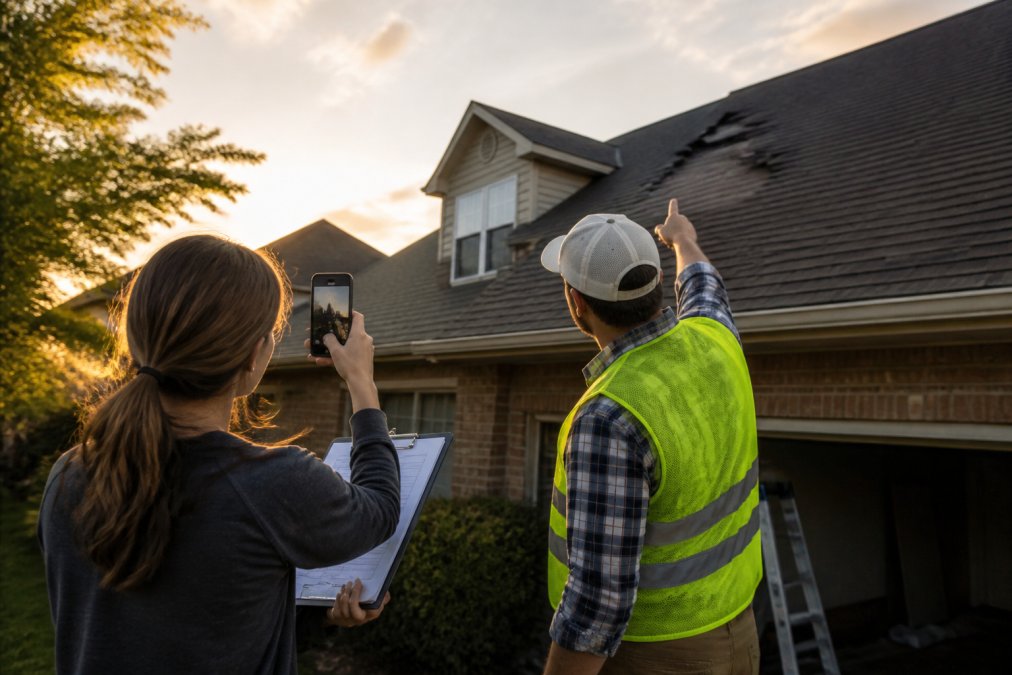
Documentation Checklist for Your Claim
Thorough documentation is the difference between a clean payout and a fight. Work through this list before the adjuster arrives:
- Wide photos of each roof slope from ground level
- Close-ups of cracked, missing, or displaced shingles
- Photos of dents on gutters, downspouts, and vents (hail evidence)
- Interior photos of ceiling stains and water damage
- Video of active dripping, if the leak is ongoing
- Receipts for any emergency repairs or tarping
- A written record of the storm date and time
- Your maintenance history, including past inspections
- An inventory of damaged personal property with photos
Photograph your roof from the same four angles every year, in good weather. When a storm hits, you have a dated baseline that shows exactly what changed, and that comparison is worth more to an adjuster than any single photo of damage.
Roof Leak Repair Cost: What to Expect
Roof leak repair cost depends on where the leak is and how far the water has traveled. A small flashing repair and a full roof replacement sit at opposite ends of the range, and the only honest way to price your situation is an on-site assessment.
That said, you can anchor your expectations. Most contractors break a leak repair into four cost components, which explains why two quotes for the “same” leak can differ by thousands of dollars.
1. Diagnosis and access. Finding the actual entry point is often the hardest part. Water can enter at a failed pipe boot and show up ten feet away at a ceiling stain. Contractors may pull back shingles, run a hose test, or use infrared scanning, labor hours before any material is touched.
2. Materials. Replacement material is usually the smallest line item. Asphalt shingles, metal panels, tile, and slate carry very different price tags, and matching an existing shingle color or profile on an older roof can require a special order.
3. Labor. This is where most of the bill lives. Steep pitch, multiple stories, and fragile materials slow the work and require fall-protection setup. A low-slope garage roof is a very different job than a three-story steep-slope roof.
4. Hidden damage. Once water reaches the decking, underlayment, or insulation, the repair grows. Rotting decking must be replaced before new roofing goes down, and wet insulation loses its R-value and should be swapped out. This line item turns a small repair into a mid-size project.
The visible leak is rarely the whole story. A ceiling stain that appeared last week may trace back to a flashing failure seeping for months. That is why a written scope of work, not a verbal estimate, matters. Ask any contractor to itemize labor, materials, and any decking or insulation replacement separately so you can compare quotes apples to apples.
What drives the number up or down:
- Roof pitch and height. Steep, tall roofs take longer to access and work on safely.
- Material. Asphalt shingles, metal, and tile carry different material and labor costs.
- Extent of damage. A single failed pipe boot is a small job. Widespread shingle loss is not.
- Hidden water damage. Once water reaches decking or insulation, the repair grows.
- Time of year and urgency. Emergency or after-hours calls typically carry a premium over scheduled work.
EFER Renovations Inc. provides quick, no-obligation estimates so you can see the real number for your roof rather than a generic range. Get the assessment before you decide whether to file, the written scope is also what your adjuster compares against when pricing the claim.
Claim vs. Repair: The Cost-Benefit Analysis
The math on filing a claim is not just the repair bill. It is the repair bill minus your deductible, weighed against the claim’s effect on your premium and claims history.
Run it in three steps:
- Subtract your deductible. If the repair costs less than your deductible, there is no financial reason to file.
- Estimate the premium impact. A single claim can raise your premium for several years, and the increase often outlasts the repair.
- Check your claims history. Too many claims in a short window can lead an insurer to non-renew your policy.
A common mistake is filing a small claim out of habit. Paying for a minor repair yourself keeps your claims record clean and preserves it for the event that actually matters.
File a claim when the damage is clearly storm-related and well above your deductible. Pay out of pocket when the repair is small, when the cause is ambiguous, or when you are close to your policy’s claim threshold.
Roof Age and Coverage Limitations
Roof age quietly limits what a policy will pay, and most homeowners discover this only after they file. Many insurers apply actual cash value rather than replacement cost once a roof passes a certain age, subtracting depreciation from your settlement (naic.org).
The difference is significant. Replacement cost pays what it takes to install a new roof today; actual cash value pays that amount minus depreciation, so an older roof returns far less. Some policies also cap roof payouts at a percentage of the dwelling limit, and a few exclude roof coverage entirely past a set age.
How Depreciation Actually Works on a Roof
Depreciation is not a flat penalty; it is calculated from the roof’s expected service life. If a shingle roof is expected to last 20 years and yours is 15, the insurer may treat it as 75% depreciated, an ACV settlement reflecting only about a quarter of replacement cost, before your deductible. The formula varies by carrier, but the mechanism is the same: the older the roof, the smaller the check.
Two policy structures change the math:
- Replacement Cost Value (RCV). The insurer pays to replace the damaged portion at today’s prices, up to policy limits. Depreciation may be withheld initially and released once the work is completed and invoiced.
- Actual Cash Value (ACV). The insurer pays replacement cost minus depreciation from day one. There is no recoverable depreciation to claim later.
Roof Age Thresholds to Check in Your Policy
There is no single national rule, but carriers commonly tighten roof coverage between the 15- and 20-year mark for asphalt shingles, and sooner in hail-prone regions. Some require a roof inspection before issuing or renewing a policy past a certain age. Others apply a separate, lower limit for the roof structure, often a percentage of the dwelling limit, rather than the full dwelling amount.
If your roof is older, check the policy language before you file. Look for three things:
- Whether the roof is scheduled as RCV or ACV.
- Whether a separate roof coverage limit or percentage cap applies.
- Whether the policy requires an inspection or excludes roof coverage past a stated age.
Knowing whether you are on replacement cost or actual cash value tells you what the claim is worth, and whether filing is worth the premium impact. If the ACV payout lands below your deductible, there is no financial reason to file, and paying out of pocket preserves your claims history for a larger event later.
Navigating Claim Denials
A denied claim is not always final. Insurers deny roof claims for predictable reasons, and several are reversible.
The most common grounds are wear and tear, lack of maintenance, and damage predating the policy period. Each can be challenged with evidence: a dated maintenance record, a prior inspection report, or clear storm documentation can move a denial to partial or full approval.
If your claim is denied:
- Ask for the denial in writing, citing the specific policy exclusion used.
- Compare that exclusion against your documentation.
- Request a re-inspection with your evidence in hand.
- Escalate to your state’s department of insurance if the insurer will not reconsider.
The National Association of Insurance Commissioners’ consumer resources outlines how to file a complaint against an insurer when a claim dispute stalls. It is a step most homeowners never take, and it often gets a denial revisited.
Do not accept a denial and move straight to repairs without a written explanation. Without the insurer’s stated reason, you cannot challenge it, and you lose the option to appeal later.
Conclusion
A roof leak is stressful enough without a denied claim on top of it. The homeowners who get paid document early, understand the difference between storm damage and wear and tear, and know when filing is worth it.
EFER Renovations Inc. has 13 years of experience helping homeowners across New Jersey and Eastern Pennsylvania through exactly this. As GAF Certified, Owens Corning Preferred, and IKO Preferred contractors, we handle 24/7 emergency repairs, offer insurance claims assistance, and back every job with a 10-year workmanship warranty. Seniors and veterans receive a 10% discount.
Get started with EFER Renovations Inc. and get a quick, no-obligation estimate before you file.
Frequently Asked Questions
Does homeowners insurance cover roof leaks caused by lack of maintenance?
No. Standard homeowners insurance policies exclude damage from lack of maintenance. If a roof leak results from worn-out shingles, clogged gutters, or deferred upkeep, the claim will likely be denied. Insurance is designed for sudden and accidental damage, like a windstorm tearing off shingles or a fallen tree punching a hole. Regular roof inspections and maintenance help you avoid the gray area where a leak could be blamed on neglect.
What type of roof damage is covered by insurance?
Most policies cover damage from covered perils such as windstorms, hail, fallen trees, and fire. If a storm rips shingles off and water enters, that leak is typically covered. Damage from wear and tear, poor installation, or lack of maintenance is not. Review your policy exclusions carefully. Some policies also have separate deductibles for wind and hail claims, so check your declarations page before filing.
How do I document a roof leak for an insurance claim?
Start by photographing the leak inside your home, including the ceiling stain, any water damage to belongings, and the roof area if it is safe to access. Record the date and time you noticed the leak. Keep receipts for emergency repairs, hotel stays, or damaged items. A written log of when the leak started and what you did to mitigate further damage strengthens your claim. Your adjuster will also inspect the roof, so clear photos help speed the process.
Is it normal for a roof to leak in heavy rain?
A roof in good condition should not leak, even in heavy rain. If it does, the cause is usually a specific failure: damaged flashing, missing shingles, or deteriorated sealant. Heavy rain can expose a pre-existing weakness, but that does not mean the leak is normal. If your roof leaks during storms, schedule an inspection. Catching the problem early can prevent structural damage and make any insurance claim more straightforward.