
Table of Contents
- Storm Damage Insurance Claims: What Counts and What to Do First
- Step 1: Secure Your Property and Document Everything
- How to Document Storm Damage for Insurance: Photo and Video Checklist
- Filing Your Claim: What to Say and What Not to Say to the Insurance Adjuster
- Understanding Your Policy: Deductibles, Coverage, and the Claims Timeline
- The Inspection Process and Handling the Adjuster’s Visit
- Hiring a Contractor for Storm Damage Repairs
- Conclusion: Your Path to a Fair Settlement
- Frequently Asked Questions
Last Updated: September 8, 2026
Storm Damage Insurance Claims: What Counts and What to Do First
A storm damage insurance claim is a formal request to your homeowners insurance policy for coverage of property damage caused by wind, hail, or water intrusion. Filing one correctly within days of the storm often determines whether you receive a fair settlement or face a denial. At EFER Renovations Inc., we have guided homeowners through this process for over 13 years.
Your first move after ensuring everyone is safe should not be calling a contractor. It should be reviewing your homeowners insurance declaration page to confirm what perils are covered, your deductible amount, and any time limits for reporting. Most standard policies cover wind and hail damage, but the distinction between replacement cost value and actual cash value matters enormously when calculating your payout.
Delaying your report, failing to mitigate further damage, or mishandling the adjuster conversation are the three fastest routes to a reduced settlement or a denial letter. Below, we walk through every step, from securing your property to negotiating a fair outcome.
Step 1: Secure Your Property and Document Everything
Your policy includes a mitigation of loss requirement, meaning you must take reasonable steps to prevent additional damage after the storm. If you leave a hole in your roof open and rain causes water intrusion into your attic, the insurer can deny coverage for that secondary damage.
Begin with temporary repairs. Cover broken windows with plywood, place tarps over damaged roof sections, and shut off water to areas with leaks. Keep every receipt for plywood, tarps, and emergency services, since your policy typically reimburses these costs. Photograph the temporary repair work itself, not just the original damage, because it proves you acted responsibly.
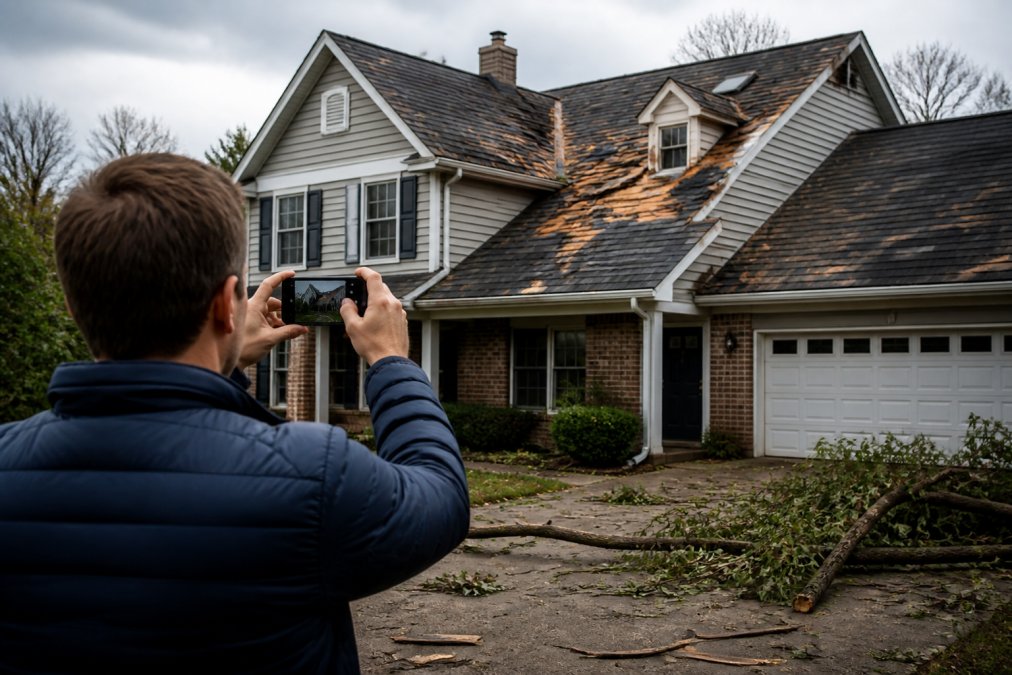
A common mistake is throwing away damaged materials before the adjuster sees them. If a tree branch punched through your siding, keep the branch and the damaged panels in a pile. Adjusters need physical evidence to justify paying for replacement, and disposing of it can weaken your claim.
How to Document Storm Damage for Insurance: Photo and Video Checklist
Documenting storm damage for insurance requires a systematic approach that starts outside and works inward. Begin with wide shots of your entire property, then move closer to capture each individual area of structural damage.
Use this exact sequence when you document storm damage for insurance:
- Capture the exterior: roof, siding, gutters, windows, and chimney from multiple angles.
- Photograph the interior: ceilings, walls, and floors where water intrusion or structural damage appears.
- Film a continuous video walkthrough narrating what you see, including the date and time.
- Record close-ups of specific damage, placing a coin or ruler next to hail impacts for scale.
- Create an inventory list of damaged personal property, noting the item, approximate purchase date, and condition.
The difference between a smooth claim and a dispute often comes down to this evidence. According to guidance from the Insurance Information Institute on filing claims, thorough documentation is one of the most effective tools a policyholder has to support their claim settlement. Do not edit or delete any photos, even ones that seem unimportant.
Never start permanent repairs before the insurance adjuster inspects the damage. Permanent repairs made in advance of the inspection can void coverage for that damage, since the insurer cannot verify the cause or extent of the loss.
Filing Your Claim: What to Say and What Not to Say to the Insurance Adjuster
The way you speak with your insurance adjuster can shape the entire outcome of your storm damage insurance claim. Report the claim by phone or through your insurer’s app, and request a claim number immediately. Write that claim number down and reference it in every future communication.
When you call, stick to the facts. State that a storm caused damage to your property on a specific date and that you have taken steps to mitigate further loss. Provide your policy number and describe the visible damage without speculating about its cause. A phrase like “the wind ripped these shingles off last Tuesday” is far safer than “this roof was probably weak and the storm finished it off.”
Equally important is knowing what not to say to the insurance adjuster. Never admit fault, speculate about pre-existing damage, or offer an opinion on repair costs. Do not give a recorded statement without reviewing your policy first, and do not accept the first settlement offer as final. The adjuster works for the insurance company, not for you, and their initial estimate is often a starting point for negotiation. Consumer guidance from the National Association of Insurance Commissioners on handling claims advises policyholders to keep a written log of every conversation, including the date, the adjuster’s name, and what was discussed.
Understanding Your Policy: Deductibles, Coverage, and the Claims Timeline
Your homeowners insurance deductible is the amount you pay out of pocket before coverage kicks in, and for storm damage it is often calculated as a percentage of your dwelling coverage rather than a flat dollar amount. A policy with a 2% hurricane deductible on a $400,000 home, for example, requires you to cover the first $8,000 in repairs. Knowing this number before you file prevents a nasty surprise when the settlement arrives.
A standard deductible is typically a flat dollar amount, $500, $1,000, or $2,500, that applies to most perils like fire, theft, or wind damage from a thunderstorm. A named storm deductible is a percentage-based deductible that applies specifically to losses caused by a storm officially declared and named by the National Weather Service, typically ranging from 1% to 5% of your dwelling coverage limit.
The trigger for a named storm deductible is not the damage itself but the storm’s official designation. If a severe thunderstorm with straight-line winds of 80 mph damages your roof, your standard deductible applies. If that same storm is later named by the National Weather Service, your named storm deductible may apply instead. Two neighbors with identical roof damage from the same weather event could face different deductibles if one property falls within the storm’s declared path and the other does not.
To calculate your exact exposure, locate the deductible section on your declarations page. You will typically see two numbers: a flat dollar amount for standard perils and a percentage for named storms or hurricanes. Multiply your dwelling coverage limit by the percentage to find your named storm deductible. On a $400,000 dwelling with a 3% named storm deductible, you are responsible for the first $12,000 of repairs before your insurer pays a dollar. That is a significant out-of-pocket figure that many homeowners discover only after the adjuster’s estimate arrives.
Your deductible is subtracted from the replacement cost value of the damage, not from the actual cash value. If your roof replacement costs $15,000 and your deductible is $2,500, the insurer pays $12,500 toward the replacement. However, if your policy pays on an actual cash value basis, the insurer first subtracts depreciation, say $4,500 for a 15-year-old roof, leaving an actual cash value of $10,500. Your $2,500 deductible is then subtracted, leaving a settlement of $8,000. The gap is your responsibility unless your policy includes replacement cost coverage for the full repair.
The storm damage claim timeline varies by state and insurer, but most policies require you to report damage promptly and file a proof of loss form within a specific window, often 60 days. A proof of loss is a formal, sworn statement detailing the damage and the amount you are claiming. Missing this deadline can result in automatic denial, regardless of how valid the claim is. Some states impose their own statutory deadlines that override policy language, so check with your state’s department of insurance if you are uncertain about the applicable window.
Confirm that your policy includes wind damage and hail damage separately, since some policies exclude one or the other. Also check your policy limits, which cap the maximum the insurer will pay. A common benchmark is that your dwelling coverage should equal at least 80% of your home’s replacement cost to avoid a coinsurance penalty, which reduces your payout proportionally if you are underinsured.
Before filing, ask your insurer directly: “Does my policy have a named storm deductible, and does the storm that damaged my property qualify as a named storm?” Get the answer in writing. This single question can determine whether you face a $1,000 flat deductible or a $12,000 percentage-based deductible.
The Inspection Process and Handling the Adjuster’s Visit
The insurance adjuster will schedule an inspection of your property to verify the damage and estimate repair costs. You have the right to be present during this inspection, and you should be. Walk the property with the adjuster, point out every area of damage you documented, and reference your photo and video files. Do not assume the adjuster will find everything on their own.
A common point of confusion is the difference between a company adjuster and a public adjuster. A company adjuster works for your insurance provider and represents their financial interests. A public adjuster is licensed and works for you, preparing the claim and negotiating on your behalf, typically for a fee of around 10% of the settlement. For complex claims involving extensive structural damage or a disputed estimate, hiring a public adjuster can be worth the cost.
The decision to hire a public adjuster is not one to make in the first 48 hours after a storm. It makes the most sense after you have received the insurer’s initial settlement offer and have reason to believe it undervalues your claim, for example, if the adjuster’s estimate is significantly lower than contractor bids, the adjuster missed visible damage you documented, or the insurer applies depreciation or exclusions inconsistent with your policy language.
A public adjuster’s role is broader than most homeowners realize. They prepare and file the proof of loss, compile supporting documentation, calculate the full replacement cost including code upgrades, and negotiate directly with the insurer’s claims department. Their fee is typically a percentage of the final settlement, commonly 5% to 15%, with 10% being the most frequent, and it is paid only when you are paid.
On a straightforward claim with minor damage and a cooperative insurer, a public adjuster’s fee can eat into a settlement you could have negotiated yourself. On a complex claim, a full roof replacement with interior water damage, for example, the difference between the insurer’s initial offer and a properly documented claim can be substantial enough that the fee is a worthwhile investment. Homeowners who hire public adjusters often see settlements 15% to 30% higher than initial offers on complex claims, though results vary.
Before hiring a public adjuster, verify their license through your state’s department of insurance, ask for references from recent storm claims, and review their fee agreement carefully. Some states cap public adjuster fees, and some prohibit them from soliciting business within a certain number of days after a disaster. Also confirm whether your policy requires you to notify the insurer before hiring a public adjuster, most do not, but the notification requirement varies by state.
During the inspection itself, the adjuster will measure your roof, check for hail impacts on vents and gutters, and assess interior water damage. Expect the visit to last 30 to 60 minutes for a standard residential claim. Afterward, the adjuster submits their report, and the insurer issues a claim settlement based on their findings. If you disagree with the estimate, you have the right to dispute it through an appraisal process, which is a formal mechanism outlined in most policies for resolving disagreements over claim value.
Appraisal is a binding dispute resolution process where you and the insurer each hire an independent appraiser, who then select a neutral umpire. If the appraisers cannot agree on the value of the loss, the umpire makes the final decision. The cost of your appraiser and half of the umpire’s fee are typically your responsibility, which is why appraisal is best reserved for claims where the value gap is significant, often $10,000 or more.
If the adjuster’s estimate seems low, do not sign anything or cash any settlement check that says “final payment.” Cashing a final payment check can be interpreted as accepting the settlement as complete. Instead, request a copy of the adjuster’s estimate, compare it line by line with contractor bids, and ask the insurer to explain any line items that are missing or undervalued.
Hiring a Contractor for Storm Damage Repairs
Hiring a contractor for storm damage repairs requires more diligence than a typical home improvement project. Start by asking for the adjuster’s estimate, then get written bids from at least two reputable contractors. Compare the scope of work, materials specified, and timelines, not just the bottom-line price.
When you hire a contractor for storm damage repairs, verify three things before signing anything: proper licensing, proof of insurance, and manufacturer certifications. Contractors certified by major roofing manufacturers like GAF, Owens Corning, or IKO have passed training on proper installation techniques, which often translates to better workmanship and stronger warranty coverage.
The most reliable contractors will handle the claims process alongside you, meeting the adjuster on site and providing detailed estimates that align with your policy coverage.
Beware of storm chasers who arrive uninvited after severe weather, offer to waive your deductible, or demand a large upfront payment. These contractors often perform substandard work and disappear before the warranty is tested. Your insurance claim number and settlement funds should never be handed over to a contractor without a signed contract that itemizes the work and payment schedule. For property owners in New Jersey and Eastern Pennsylvania, EFER Renovations Inc. provides this coordinated approach, pairing 24/7 emergency support with certified installation crews and direct insurance claims assistance.
Conclusion: Your Path to a Fair Settlement
Filing a storm damage insurance claim is a process of discipline: document everything, secure your property immediately, communicate carefully with the adjuster, and never accept a first offer without scrutiny. The homeowners who navigate this successfully treat it like a part-time job, keeping logs, meeting deadlines, and understanding the difference between replacement cost value and what the insurer initially offers. Federal guidance from FEMA on disaster assistance and insurance reinforces that insurance is the primary means of recovery after a disaster, which makes getting the claim right the first time essential.
When the repairs are substantial, the right contractor becomes your strongest ally in the claims process. EFER Renovations Inc. brings over 13 years of exterior renovation experience to New Jersey and Eastern Pennsylvania homeowners, with GAF, Owens Corning, and IKO certified crews who know how to document damage and communicate with adjusters effectively. Our 5.0 average rating across 73 Google reviews reflects a track record of finishing work on time and standing behind it with a 10-year workmanship warranty.
Get started with EFER Renovations Inc. and turn a stressful claims process into a straightforward path back to a secure, durable home.
Frequently Asked Questions
How long after storm damage can I file a claim?
Most homeowners insurance policies require you to file a claim within one year of the storm event, but some carriers shorten that window to six months. Check your policy documents for the specific deadline. In practice, you should notify your insurer within days of the damage. Delaying can complicate your claim and give adjusters reason to question whether the storm caused the damage. After you file, your insurer must acknowledge the claim promptly and typically completes the investigation within 30 days.
What should I avoid saying to the insurance adjuster?
Never admit fault, guess at the cause of damage, or accept the first settlement offer on the spot. Do not say ‘I think it was already like that’ or ‘We might have waited too long.’ These statements can be used to reduce your payout. Stick to the facts you documented, describe visible damage only, and refer to your contractor’s assessment for repair estimates. If you are unsure about a question, say you need to check your records before answering.
Do I need a professional inspection before filing a storm damage claim?
A professional inspection is not required to file a claim, but it is strongly recommended. Your insurance company will send its own adjuster, yet that adjuster works for the insurer, not for you. A licensed contractor’s inspection provides an independent damage assessment and a repair estimate you can use to compare against the adjuster’s figures. This evidence helps during settlement negotiations, especially if the adjuster undervalues structural damage like a roof that needs full replacement rather than simple repairs.